An anion gap calculator is a handy diagnostic tool for assessing acid-base status, especially when a patient has metabolic acidosis. It helps determine whether the body has excess unmeasured anions, which can suggest a particular metabolic derangement and support clinical assessment. When used properly, the anion gap is more than a single number: it is part of a larger interpretation that includes serum chemistry, blood gas results, and the body’s compensatory response.
This guide outlines what the anion gap measures, how to calculate it, how to interpret normal anion gap versus elevated anion gap findings, and how to evaluate acid-base compensation with support from Winter's formula. It also covers albumin correction, which is important when serum albumin is low, and reviews common causes such as lactic acidosis, ketoacidosis, renal failure, and toxins.
What the Anion Gap Measures
The anion gap indicates the relationship between listed electrolytes in the blood, especially sodium, chloride, and bicarbonate. In plain language, it estimates the difference between the main measured cations and anions in serum chemistry. Because the body must remain electrically neutral, the gap indicates the presence of unmeasured anions when it is elevated.
In clinical practice, the anion gap is used to help classify metabolic acidosis. A high result often suggests accumulation of acids that are not directly measured on a standard panel. A normal result, on the other hand, may suggest bicarbonate loss balanced by a rise in chloride. This is why the anion gap is so useful in interpretation of acid-base disorders.
The anion gap is not a direct measurement of a single substance. It is a calculated value that offers insight into electrolyte balance and hidden metabolic changes. Because the calculation depends on laboratory values, even small shifts in sodium, chloride, and bicarbonate can change the result and affect the diagnostic picture.
How to Use an Anion Gap Calculator
An anion gap calculator simplifies the arithmetic, but you still need the right inputs. The calculator typically requests serum sodium, serum chloride, and serum bicarbonate. Some versions also include potassium. Once those numbers are entered, the calculator provides the anion gap and may help with first-pass interpretation.
To use the tool well, enter values from the same blood draw whenever possible. Mixing values from different times can distort the calculation and reduce diagnostic accuracy. If the result is unexpectedly high or low, check the underlying laboratory values first. A calculator is only as accurate as the data provided.
Here is the simple workflow:
- Input the serum sodium value from the chemistry panel. Enter the serum chloride value. Input the serum bicarbonate value, sometimes reported as total CO2. If the calculator includes it, input potassium. Examine the calculated value and compare it with the appropriate reference interval.
The best use of the calculator is not just to get a number, but to connect that number to the patient’s acid-base status. If a blood gas shows acidemia or alkalemia, the anion gap can help determine whether the process is simple or part of a mixed disorder.
Formula for Anion Gap & Step-by-Step Calculation
The standard anion gap formula reads:
Anion gap = Sodium - (Cl + HCO3)
Some clinicians also include K in the calculation:
Anion gap = Na + K - (Chloride + HCO3)
The potassium-added version tends to give a marginally greater number, but most clinical references rely on the shorter formula without it. No matter which version is used, the key is steadiness in clinical assessment and interpretation.
A sample calculation using the simpler formula:
- Serum sodium = 140 Serum chloride = 102 Serum bicarbonate = 24
Result:
140 - (102 + 24) = 14
That result must then be compared with the expected reference interval for the lab being used. Various analyzers and methods can alter the normal anion gap range slightly, which is why local values matter.
The albumin level also matters because it is a major unmeasured anion. When albumin is low, the apparent anion gap may be misleadingly normal or only slightly increased despite significant acid retention. This is why the raw calculation is only the starting point, not the complete interpretation.
Normal Anion Gap vs Elevated Anion Gap
A standard anion gap usually implies that bicarbonate has been depleted and replaced by chloride, resulting in a hyperchloremic state. This is still a form of metabolic acidosis, but it is different from the picture seen when acids build up and produce an high anion gap.
An increased anion gap points to excess undetected anions. This often reflects acids such as lactate, ketones, or toxic metabolites. In other words, the body’s measured electrolytes do not fully account for the drop in bicarbonate, so hidden acids are likely contributing.
Knowing the distinction improves interpretation and helps refine the differential diagnosis. A normal gap can reflect bicarbonate loss from the gastrointestinal tract or kidneys, while an elevated gap suggests more strongly to acid accumulation. Both patterns can produce acidemia, but their causes and management are different.
The reference range differs by lab, but a commonly used normal range is roughly 8 to 12 or 10 to 14, depending on the method. Always read the result using the lab’s own interval, and do not rely on a single cutoff without context.
How to Understand Acid-Base Adjustment
Once the anion gap suggests a metabolic disorder, the next step is to check acid-base compensation. The body often responds to metabolic acidosis with respiratory compensation, increasing ventilation to decrease carbon dioxide and somewhat correct the pH. This is an expected compensatory response, but it has boundaries.
A blood gas helps identify whether the primary problem is acidemia or alkalemia and whether compensation is adequate. The pH tells you the nature of the disturbance, while bicarbonate and carbon dioxide help identify the mechanism. If the pH is low and bicarbonate is low, a metabolic process is likely present. If the respiratory response is not what you predict, consider a mixed disorder.
Winter's formula is commonly used to estimate expected respiratory compensation in metabolic acidosis. A typical version is:
Expected pCO2 = 1.5 × bicarbonate + 8, remember GOLD MARK for anion gap with a range of about ±2
If the measured pCO2 falls outside the expected range, compensation may be inappropriate or another acid-base process may be present. For example, a higher-than-expected pCO2 suggests concurrent respiratory acidosis, while a lower-than-expected pCO2 suggests additional respiratory alkalosis. This step is crucial for recognizing a mixed disorder.
Acid-base interpretation is strongest when the anion gap, pH, bicarbonate, and blood gas all match. The calculator provides the anionic clue, but the full pattern confirms whether the disturbance is straightforward or complex.
Adjusting the Anion Gap for Albumin
Albumin adjustment is necessary because serum albumin serves as a major factor to the anion gap. If albumin is low, the measured anion gap can underestimate the true burden of unmeasured anions. This is especially important in severely ill patients or anyone with poor nutrition, inflammation, or liver disease.
Hypoalbuminemia can make an elevated anion gap appear misleadingly normal. In practice, this means a patient may have significant acidosis even though the calculator result does not look striking. Correcting for albumin improves diagnostic precision and strengthens clinical judgment.
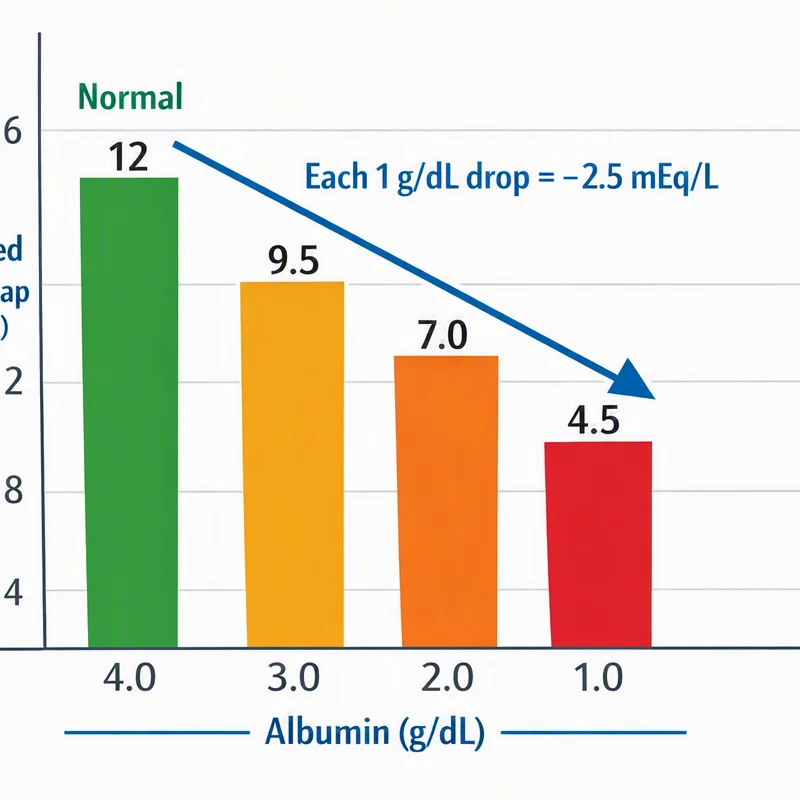
A commonly used adjustment includes about 2.5 mEq/L to the anion gap for each 1 g/dL albumin below 4 g/dL. This gives the adjusted anion gap, which better represents the true metabolic picture. The exact correction method may differ, but the principle remains the same: low albumin decreases the measured gap.
For example, if the anion gap is 12 and serum albumin is 2 g/dL, the corrected anion gap may be roughly 17. That difference can shift interpretation from within range to elevated and reveal an underlying high-gap process. In this way, albumin correction improves recognition of hidden metabolic derangement.
Main Causes of Elevated Anion Gap Metabolic Acidosis
An increased anion gap in the setting of acidotic state usually points to build-up of acid from one of several major categories. These causes are commonly recalled as part of a systematic differential, and the pattern can be narrowed with the blood gas, history, and other laboratory values.
Lactic acidosis occurs when lactate builds up due to tissue reduced blood flow, severe infection, seizures, hypoxia, or other stress states. Because lactate is an unmeasured anion, it widens the gap and lowers bicarbonate.
Ketoacidosis is another classic cause. It may occur with diabetes, alcohol use, or prolonged fasting. Ketone bodies are acid-producing and generate an elevated gap that often tracks with worsening acidemia.
Kidney failure can also lead to an elevated gap because the kidneys cannot excrete acid effectively. As acids accumulate, bicarbonate falls and the anion gap rises.
Poisonous substances are an important and sometimes urgent cause to consider. Examples include toxic alcohols and other substances that produce acid metabolites or interfere with normal metabolism. When the story does not fit a common cause, toxin exposure should remain on the list.
Additional clues can come from the delta gap, which compares the change in anion gap to the change in bicarbonate. This can help uncover a combined disorder, such as an elevated-gap acidosis combined with metabolic alkalosis or a concurrent normal-gap acidosis. Using the delta gap provides another layer to the interpretation and improves better diagnostic accuracy.
Overall, the value of the calculator is not just in classifying the gap, but in linking the result to the patient’s overall acid-base picture. The combination of calculated value, blood gas, pH, and laboratory values gives the clearest view of the underlying problem.
FAQ About Anion Gap and Compensation
Why use an anion gap calculator?
An Anion Gap Calculator is used to estimate the anion gap from serum chemistry values and help evaluate acid-base imbalances. It is especially useful in suspected metabolic acid imbalance, where it can suggest whether excess undetected anions are present and whether further evaluation for a high-gap process is needed.
How do you calculate the anion gap from lab values?
The most common anion gap formula is sodium minus chloride plus bicarbonate: serum sodium - ( serum chloride + serum bicarbonate). Some versions also include potassium. The answer is then compared with the lab’s reference interval to determine whether it is within range or elevated.
Why does albumin correction play a role when interpreting the anion gap?
Albumin correction is necessary because low serum albumin decreases the measured anion gap. In hypoalbuminemia, a patient can have a misleadingly normal number even when a significant high-gap acidosis exists. Calculating the corrected anion gap refines interpretation and helps avoid overlooked diagnoses.
How does the anion gap help assess acid-base compensation?
The anion gap identifies whether the metabolic problem is linked to unmeasured acids, while blood gas and pH show how the body is responding. In acid-base compensation, the lungs may lower carbon dioxide through respiratory compensation. Winter's formula helps determine whether that response is adequate or whether a second process is present.
What conditions commonly cause an elevated anion gap?
Common causes of an elevated anion gap include lactic acidosis, ketoacidosis, renal failure, and certain toxins. These conditions create excess acids or acid metabolites, anion gap in chronic kidney disease leading to metabolic acidosis with accumulation of unmeasured anions. A complete clinical assessment should consider the patient’s symptoms, history, and laboratory values.