An Anion Gap Calculator is a useful tool for interpreting blood test results, especially when clinicians are checking for an acid-base disorder or an imbalance in electrolytes. To see what the calculator is actually showing, it helps to know the difference between measured anions and unmeasured anions. That difference is the core of the anion gap, a calculated value that offers an useful diagnostic clue in the right medical context.
At a basic level, an anion is a negative-charge particle. Blood chemistry depends on a careful balance between positive charge and negative charge, and that balance is described by the principle of electroneutrality. While the body contains many charged substances, only some are routinely reported on a standard lab test. Others are present in serum but are not directly included in the usual electrolyte measurements. Recognizing this distinction makes it easier to interpret lab values and recognize an underlying cause of abnormal results.
What are anions in laboratory blood analysis?
In clinical testing, an negatively charged ion is any ion or ion with a negative charge. These substances help determine the overall blood serum concentration of charged particles in the body. Since blood needs to remain electrically balanced, the total amount of positive charge roughly matches the total amount of negative charge, even though individual substances may go up or down.
Negatively charged ions are part of the broader group of electrolytic molecules, which includes both negatively charged and positively charged ions. In a typical clinical chemistry setting, clinicians focus on a small set of these ions because they are central to fluid balance, kidney function, and acid-base regulation. The remainder are present in serum but are not routinely measured on standard testing.
Many clinically important anions are tied to the body’s metabolic state. Some are involved in transport, some are anions attached to proteins, and others are acidic organic substances that can increase during illness. This is why a blood test result can be more than just a number: it can point toward a metabolic disturbance or a change in renal function. The anion gap helps summarize part of that chemistry by comparing what is measured against what is not.
What are reported anions?
Reported anions are the negatively charged substances routinely shown on a routine lab test or electrolyte screen. The main examples are chloride and bicarbonate. Though sodium is not an anion, it is often included in the formula because it is the major measured cation and forms the positive side of the balance.
On a standard test, sodium, chloride, and bicarbonate are the most important lab values used to calculate the anion gap. Each is essential in a different way. Sodium represents the major extracellular cation, chloride helps preserve charge balance, and bicarbonate acts as a major buffer in acid-base regulation. Together, these measurements provide a snapshot of the body’s electrolyte pattern and help clinicians assess acid-base balance.
These measured values are part of the usual serum electrolytes obtained in many clinical settings. Their importance lies not only in the numbers themselves, but also in how they relate to one another. For example, a drop in bicarbonate with a corresponding rise in chloride may suggest a non-gap metabolic disturbance, while a drop in bicarbonate with an increase in unmeasured anions can point to a high anion gap process.
In other words, measured anions are the apparent portion of the chemical picture. They are the substances a lab test directly reports, and they form the foundation for the Anion Gap Calculator’s calculated value.
What are unmeasured anions?
Unmeasured anions are negatively charged substances present in serum that are not routinely included in the standard electrolyte panel. They are still part of the body’s ionic balance, but they do not appear directly in the routine blood chemistry numbers used in the anion gap calculation. Frequent examples include albumin, phosphate, sulfate, and lactate.
Albumin is especially important because it is one of the most abundant negatively charged proteins in blood. Even though it is not always thought of as a classic electrolyte, it strongly influences the charge balance. Phosphate and sulfate also contribute to the pool of unmeasured ions. Lactate becomes especially relevant when tissues are under stress or oxygen delivery is impaired, since elevated lactate can be a significant contributor to metabolic acidosis.
Other unmeasured anions include ketones, which can rise during fat metabolism when glucose cannot be used normally. These substances matter because they can accumulate without being directly reflected in the routine lab report. That is why the anion gap serves as a practical estimate of the gap between what is measured and what is chemically present in the serum.
In practice, unmeasured anions often provide the real clue to the delta ratio in mixed acid base underlying cause of an abnormal result. They are a key part of the medical context, especially when the blood test shows signs of acid-base disturbance but the routine electrolyte numbers do not fully explain why.
How the anion gap is calculated
The anion gap is a formula-based estimate that contrasts the main measured cations and anions to infer the amount of unmeasured charge in the blood. The standard formula is:
Anion gap = sodium − (chloride + bicarbonate)
This formula works because of electroneutrality. Blood must preserve nearly equal total positive and negative charge, so if the measured ions do not fully account for the expected balance, the difference is linked to unmeasured anions. In this way, the gap is not really a “gap” in the chemistry; it is a derived estimate of what is missing from the basic serum electrolytes.
An Anion Gap Calculator applies this formula quickly and consistently. Clinicians use it to interpret serum electrolytes in context rather than in isolation. The result can help identify acid-base problems, follow changes over time, and support further evaluation when lab values are abnormal.
Because the anion gap depends on measured numbers, the result is only as accurate as the input data. Small shifts in sodium, chloride, or bicarbonate can change the calculation. That is why the interpretation guide matters: a single result should be viewed alongside symptoms, history, renal function, and other lab findings rather than treated as a standalone diagnosis.
What does a high anion gap mean?
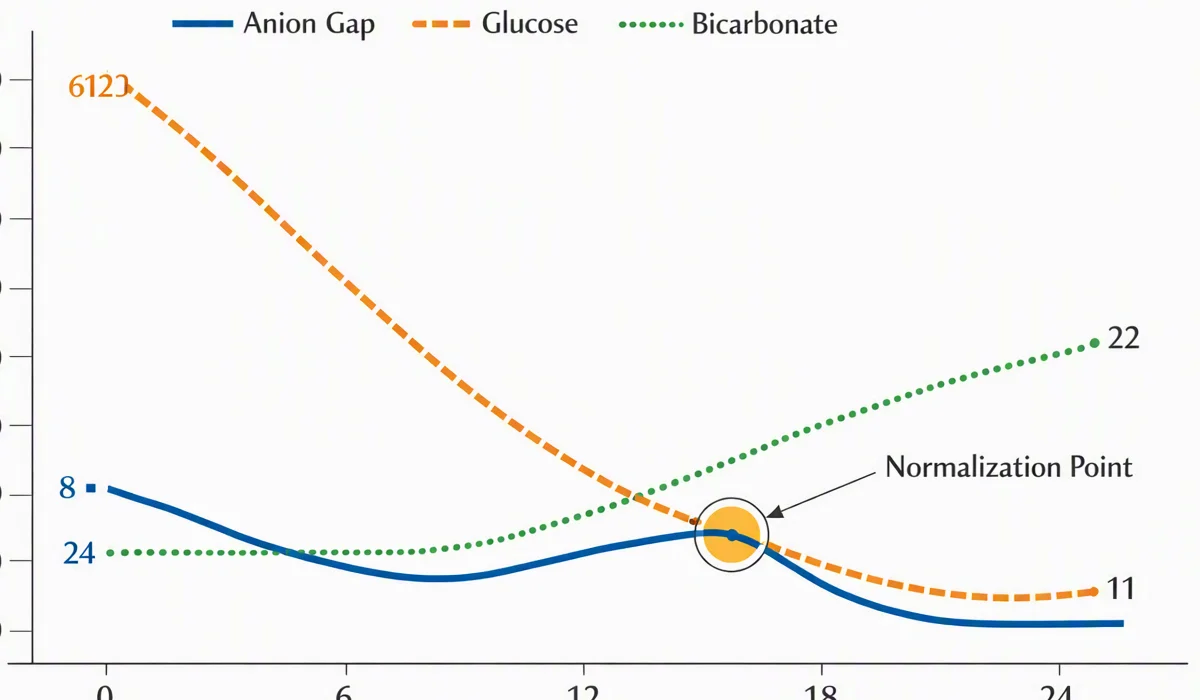
A high anion gap often means there are elevated unmeasured anions within the blood. This pattern is frequently associated with metabolic acidosis, a metabolic imbalance in which the body has built up acid or reduced bicarbonate in a way that is not adequately countered by chloride. The elevated gap is a diagnostic clue that encourages clinicians to identify the underlying cause.
One common cause is ketoacidosis. When the body metabolizes fat for energy, ketones accumulate and act as unmeasured acids. Another important cause is lactic acidosis, where lactate builds up because of reduced oxygen supply, severe illness, or impaired metabolism. Both conditions can cause significant shifts in blood test results and need prompt medical attention.
Toxic alcohols are another classic cause of a high anion gap. Certain ingestions can result in the generation of acid metabolites that raise the burden of unmeasured anions. In these cases, the gap can be an early warning sign before the full clinical picture becomes obvious.
Other causes may involve kidney dysfunction, shock, or severe metabolic disturbance. In every case, the high gap reflects a change in the balance between measured and unmeasured components. It is not the diagnosis itself, but it can strongly suggest the diagnosis when interpreted correctly.
What does a typical or reduced anion gap mean?
A normal anion gap does not always mean all is well, and a decreased anion gap can also be important. In some cases, the result is explained by hypoalbuminemia, which means a low albumin level. Since albumin is a major unmeasured anion, decreased albumin lowers the expected gap and can make an otherwise concerning process appear less obvious.
A reduced or surprisingly normal result can also be caused by laboratory error. Because the anion gap is calculated from other values, even small measurement issues in sodium, chloride, or bicarbonate can affect the final number. This is why doing again the test or examining the full electrolyte panel is often an important step if the result does not align with the clinical picture.
Hyperchloremia can also lower the gap. If chloride rises, the formula may produce a reduced calculated value even when other aspects of acid-base balance are abnormal. Similarly, paraproteinemia can create a reduced anion gap because abnormal proteins may carry charge and shift the expected balance of measured and unmeasured ions.
In short, a normal or reduced result should be read thoughtfully. It may reflect a real physiologic pattern, a change in albumin, an issue with the lab test, or an effect of another medical condition. The number alone is not sufficient; interpretation depends on the broader medical context.
How to read outcomes from an Anion Gap Calculator
Using an Anion Gap Calculator is simplest when you think of it as an interpretation guide rather than a diagnostic tool. The calculator applies the main serum electrolytes, uses the formula, and gives a result that can be compared with the expected reference range. That comparison helps show whether the gap is normal, high, or low.
From there, the result should be considered alongside the broader electrolyte panel, symptoms, and clinical history. If the gap is high, the next question is usually what unmeasured anion is responsible. If the gap is low or normal but there is still concern for illness, the question becomes whether albumin is low, whether there is hyperchloremia, or whether another factor is masking the abnormality.
Clinical interpretation also depends on acid-base balance. The anion gap is most valuable when there is concern for acidosis or another metabolic disturbance. It does not replace a full evaluation, but it can narrow the possibilities and guide the workup. In that sense, it is a bridge between raw lab values and clinical significance.
When interpreting results, it is also useful to ask:
- Are the serum electrolytes internally consistent? Is albumin low enough to affect the calculation? Do the symptoms match a high or normal gap pattern? Is there a likely underlying cause such as lactic acidosis, ketoacidosis, or toxic alcohol exposure? Could the result reflect laboratory error or paraproteinemia?
These questions help make a calculated value into a useful clinical clue. The calculator is not the final answer, but it can sharpen thinking and support timely medical evaluation.
Typical questions about measured and unmeasured anions
The difference between measured and unmeasured anions is central to understanding the anion gap, but it also raises practical questions. The FAQ below addresses the most common ones and connects them to diagnosis, symptoms, and medical evaluation.
What is the distinction between reported and unmeasured anions?
Detected anions are the negative-charge substances listed directly on routine blood tests, most notably chloride and bicarbonate. Not directly measured anions are negative-charge substances in the blood that are not included in the standard electrolyte panel, such as albumin, phosphate, sulfate, lactate, and ketones. The gap between them is what the anion gap helps estimate.
Which anions are usually measured on a standard electrolyte panel?
A standard electrolyte panel usually includes sodium, chloride, and bicarbonate. Sodium is the main measured cation used in the anion gap formula, while chloride and bicarbonate are the primary measured anions. These lab values provide the basis of the calculation and provide essential information about acid-base balance and electrolyte imbalance.
Why does albumin affect the anion gap?
Albumin affects the anion gap because it is a significant unmeasured anion in blood. When albumin is reduced, as in hypoalbuminemia, the anion gap may look lower than expected. This can obscure an underlying acid-base disorder, so albumin correction is often essential for accurate clinical interpretation.
What conditions cause a high anion gap?
A high anion gap is commonly caused by metabolic acidosis with accumulation of unmeasured acids. Major causes include lactic acidosis, ketoacidosis, toxic alcohols, kidney-related metabolic disturbance, and other conditions that raise organic acids or ketones. The pattern is a diagnostic clue, but diagnosis requires medical context and further evaluation.
Can a normal anion gap still indicate a medical problem?
Yes. A normal anion gap can still occur with illness, especially if the issue is a non-gap acid-base disorder, if albumin is low, or if the result is affected by laboratory error. Hyperchloremia, paraproteinemia, and other conditions can also affect interpretation. If symptoms or other blood test results are concerning, a medical evaluation is still necessary.
Understanding measured and unidentified anions makes the Anion Gap Calculator greater than a math tool. It acts as a useful way to read blood chemistry, spot a likely acid-base disorder, and connect lab results to the clinical significance of what is happening in the body.